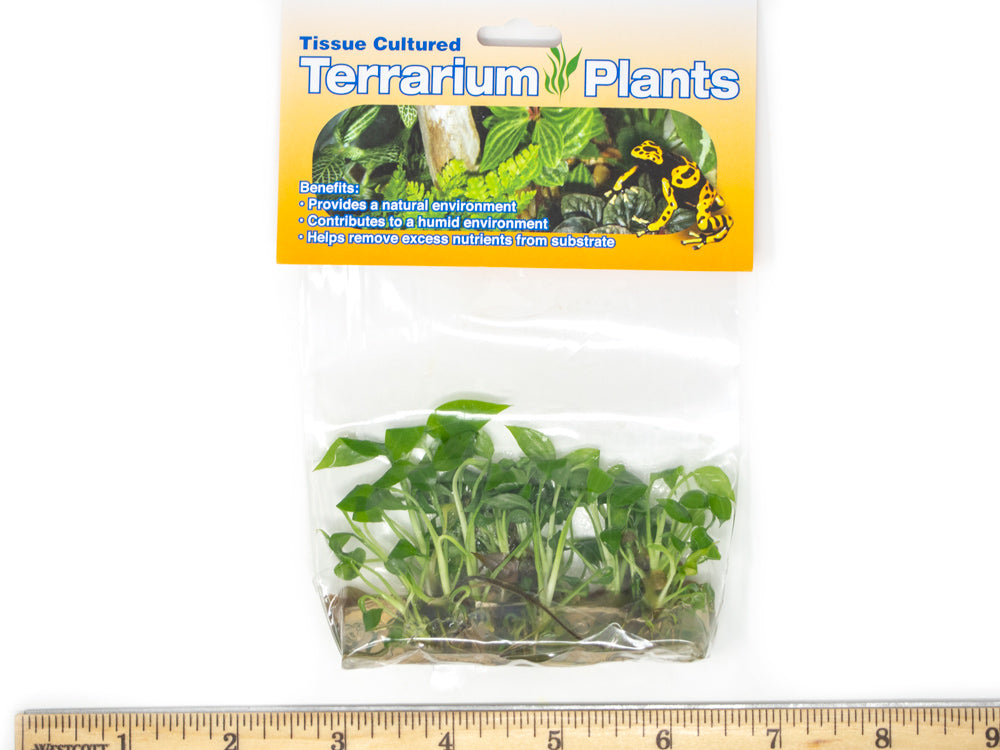
peace lily aquarium plant Peace Lily (Spathiphyllum wallisii) Tissue Culture
SKU: 72501282509
peace lily aquarium plant

peace lily aquarium plant Peace Lily (Spathiphyllum wallisii) Tissue Culture

Sale price$20.16 Regular price$22.40
Save 10%

Pay in installments of $5.60 with ShopPay, AfterPay and Klarna

Shipping Estimate
USA
  • USA
  • CAN

Ships within 48 hours · Estimated delivery Jun 30 - Jul 5

Promo Codes Available:

For Your Every Summer RSVP, with Code: SUMMER15

Description

peace lily aquarium plant Peace Lily (Spathiphyllum wallisii) Tissue CultureThe Peace Lily is an extremely hardy and versatile plant that thrives in the terrarium, vivarium, or paludarium setting! The Peace Lily (Spathiphyllum wallisii) is a tropical evergreen flowering plant that is native to Central America. It is a very popular houseplant and many cultivars have been developed through selective propagation and hybridization. Since it thrives in humid environments and has a very elegant appearance, the Peace Lily is also an


The Peace Lily is an extremely hardy and versatile plant that thrives in the terrarium, vivarium, or paludarium setting!


The Peace Lily (Spathiphyllum wallisii) is a tropical evergreen flowering plant that is native to Central America. It is a very popular houseplant and many cultivars have been developed through selective propagation and hybridization. Since it thrives in humid environments and has a very elegant appearance, the Peace Lily is also an excellent plant for the terrarium, vivarium, and paludarium. 


The Peace Lily can grow to a rather impressive size, so it is an excellent middle or background plant in the terrarium. It can be considered semi-aquatic, but only its roots can be submerged for it to tolerate that condition. When planted traditionally, its soil should be moist, but not soggy. It can tolerate many levels of lighting, but it will do best under indirect or filtered lighting. It may brown under extreme direct lighting.


Specialty fertilizers exist for potted houseplant use, but many such fertilizers can be harmful in a terrarium or paludarium. The Peace Lily is a versatile, adaptable plant and generally does not need supplemental fertilizers in terrarium, vivarium, and paludarium settings.  


This listing is for the tissue culture form of Peace Lily. Tissue cultures are superior to traditional forms of aquarium plants in many ways. They are produced in a completely sterile environment which eliminates the possibility of them carrying pest animals or algae spores. They have a shelf life (before introduction to the aquarium) of several months if properly maintained and they are housed in a nutrient gel until introduced to the terrarium. To introduce a tissue culture plant to the terrarium, simply rinse off as much nutrient gel as possible, then plant as usual. The nutrient gel will not harm your terrarium.  


What We Like About This Plant:

  • Tissue cultures contain no unwanted pest animals or algae
  • Produces beautiful foliage and flowers
  • Lush growth
  • Easy care
  • Hardy and adaptable 


Care Guidelines:

  • Lighting: Moderate to High, Indirect
  • Origin: Lab-grown tissue culture, but indigenous to Central America
  • Terrarium placement: Midground to Background
  • Care: Easy
  • USDA Hardiness Zones: 11-15


All Aquatic Arts brand plants and animals come with a 100% live arrival guarantee, plus free email support!

Shipping Notes
  • Free Standard Shipping on $100+ Orders to the USA.
  • Except Preorder products are shipped in 48 hours.
  • Delivery to the USA:
  1. Standard Shipping : 3-10 business days
  • If time is of the essence, please consider selecting expedited delivery for faster service.
Exchange/Return Notes
  • We offer a 30-day return/exchange service after receiving.
  • Final sale items are not eligible for returns or exchanges.
  • To process your return/exchange, please contact us at [email protected]
  • Please click here for more details>>> Return & Exchange Policy
SKU: 72501282509

Discover Niche Categories That Outsell peace lily aquarium plant

Top-Converting Item to Boost Your Average Order

4.5 ★★★★★
Based on 1286 reviews
Sort
Highest Rating
Newest First
Oldest First
Product Reviews
J
Verified Purchase
JM
Whiting, US
★★★★★ 3
Not good
Size: 30 Count (Pack of 1)
Didn’t help and I woke up with a headache. Natrol 1 mg time release is better for me but it’s not available any more.
WAS THIS REVIEW HELPFUL?YesReportShare
Reviewed in the United States on October 9, 2025
A
Verified Purchase
Amazon Customer
Whiting, US
★★★★★ 5
Best I've used yet.
Size: 60 Count (Pack of 1)
I like the slow release. It works great for all night relaxation.
WAS THIS REVIEW HELPFUL?YesReportShare
Reviewed in the United States on March 8, 2026
A
Verified Purchase
Andrea S Percell
Lexington, US
★★★★★ 5
Wow
Format: Paperback
A great book to sit back and read to learn about the origins our ancient ancestors. Very informative and interesting.
WAS THIS REVIEW HELPFUL?YesReportShare
Reviewed in the United States on October 4, 2025
E
Verified Purchase
Evelyn Andrews
Birmingham, US
★★★★★ 5
Best read
Format: Paperback
Great book
WAS THIS REVIEW HELPFUL?YesReportShare
Reviewed in the United States on March 29, 2026
C
Verified Purchase
Cosmosf
Massapequa, US
★★★★★ 5
From Babylon to Timbuktu
Format: Paperback
What I like about this book is how it truly I must say base all it information on facts and allows the reader to search for themselves that truth. Very informative reading! There are many books such as this, which goes along with what the authour here is stating. A well written and well research issue, I have yet to come across. This book invites anyone, no matter of race or ethnicity, to see the real, yet truth behind ones identity as respects where He/She came from when it comes to the lineage of Noah's three sons: Ham, Shem, Japheth. It breaks it down using Biblical though logic to determine who, when, where, how, the races came about. A Must Read!!! Let truth be told... who the true sons of Noah (Ham, Shem, Japheth) when it relates to my culture (as a Negro or Hebrew Israelite). What's interesting about this book is how it goes into by way of explaining, through a series of logics base on facts, showing you the differention between the two Sons of Noah: Ham and Shem (who were actually of non-colour), according to their identity. The Bible is clear on this fact, however, the "myth" that Ham was "curse" as a race which lead to their skin colour turning Black, which lead to the mass genocide and reason for slavery. It is rather interesting how many miss the two of Noah's Sons: Ham & Shem being of non-colour and that Yeshua (Jesus) was actually from the line of Shem, therefore, being a person of non-colour... According to the actual fact presented, HAM in the Bible had four (4) sons: Cush (Ethiopia), Mizraim (Egyptians), Phut (Libya -N.Africans), Canaan (S.Africa). These were the progenitour of the Dark Races, NOT the Negroes!(Genesis 10:6) The Negroes were from Shem, who were the Hebrew Israelites! However, the progenitours of Japheth was the Greek, Romans, Europeans or the Caucasians. According to Alexander Hamilton Bible Dictionary pg. 330, defines HAM: "The youngest son of Noah born probably about 96 years, before the flood. One of the 8 person to live during the flood. He became the progenitor of the dark races, Not the Negroes, but the Egyptians, Ethiopians, Libyans, and Canaanites." A MUST READ!!!
WAS THIS REVIEW HELPFUL?YesReportShare
Reviewed in the United States on September 20, 2010

recommand products